
Patagonia Hiking: Compare Your Options in 2026
This page contains affiliate links to Trip.com: we earn a commission if you buy through one, at no extra cost to you.
Choose Patagonia hiking by day-base or linked-trek structure. Compare southern walking areas, full returns, guide support, route effort and travel days.
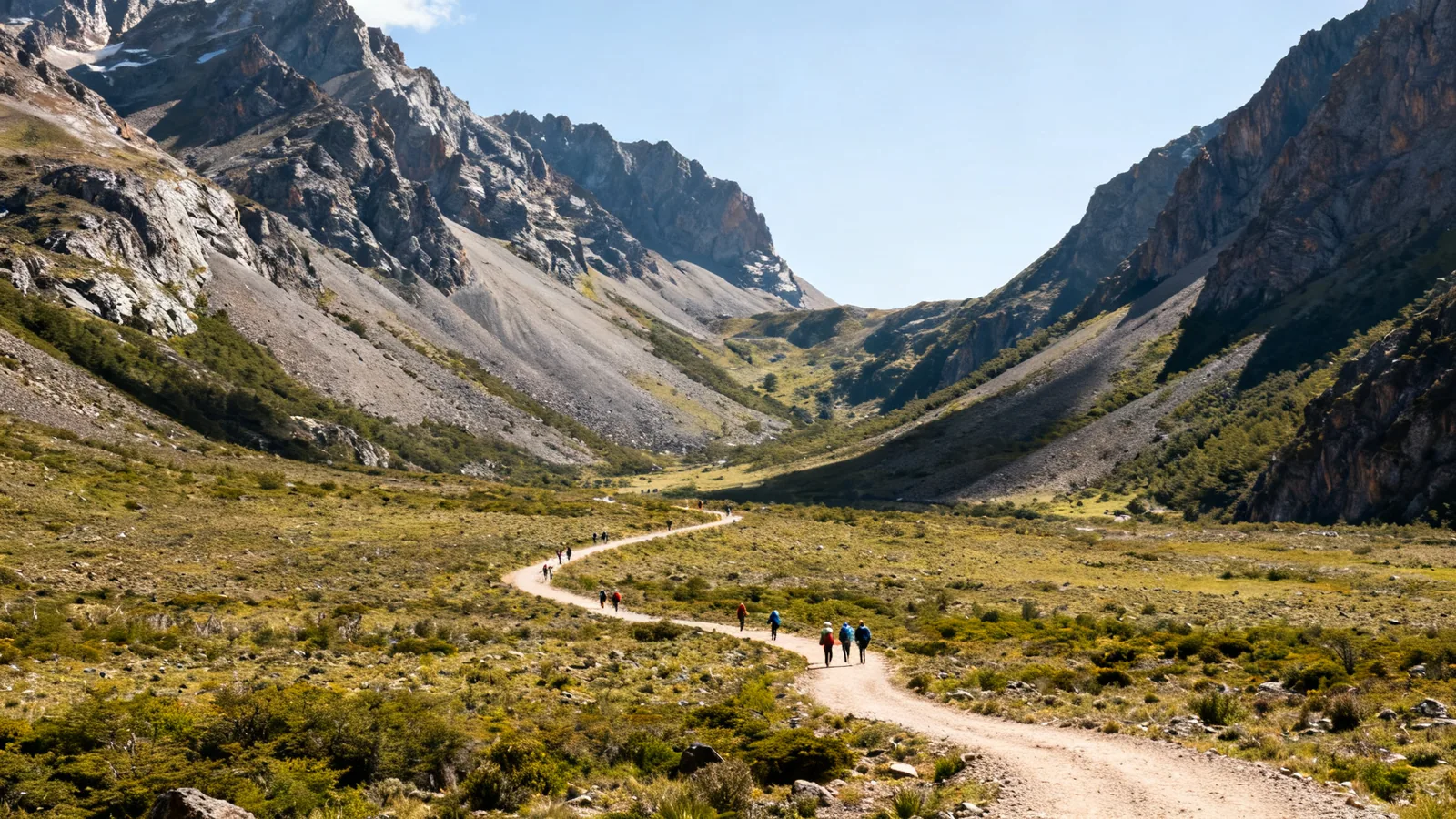
Illustrative scene: a wide Patagonian mountain valley with a winding trail and tiny hikers.
Keep the planning layers distinct
A Patagonia hiking base creates a different daily plan from consecutive trail nights.
Complete planning records
Layer: Day base
- What it represents
- Return to the same town room
- Decision to verify
- Choose objectives from current advice
Layer: Linked trek
- What it represents
- Finish at the next trail night
- Decision to verify
- Confirm the complete sleeping sequence
Layer: Two-area stay
- What it represents
- Travel before another walking base
- Decision to verify
- Count transfer days separately
Primary route or operator reference · · Original table; cited factual basis. No source artwork copied.
Guided Base Torres day hike from Puerto Natales
- Best for
- Walkers choosing a demanding guided day hike in Torres del Paine with a Puerto Natales return.
- Trade-off
- This is one hiking day, not a multi-day Patagonia package. Check fitness, age terms, park entry and meals before booking.
Patagonia hiking starts with choosing a walking pattern: day routes from an El Chalten room, linked trekking nights in Torres del Paine, or shorter landscape outings around a fixed base. Pick the pattern from usable days and the hardest walk your party can manage. Then choose the route, dates and support that make it work.
This guide focuses on southern Chile and Argentina, where the region's well-known trekking areas create very different trips. A glacier boat, a walkway visit and a mountain ascent can all belong in one holiday. But they should not be counted as the same kind of hiking day.
Area choice: use a town base for daily flexibility, a linked trek for a continuous route, or a guided room-based stay for support without moving beds every night. Compare full walking returns and real travel days before adding another area.
Choose the hiking area from the trip structure
El Chalten offers a town-based approach to the northern Los Glaciares routes. Torres del Paine supports linked W and O trekking as well as selected day visits. El Calafate is the main comparison base for a Perito Moreno outing. These places can be combined, but the moves between them cost usable time.
| Area or structure | Main walking pattern | Best reason to choose it | Main task |
|---|---|---|---|
| El Chalten town stay | Pick a day route and return to town | Reorder walking days around conditions and energy | Enough full days, current trail advice and food |
| Torres del Paine W | Link trail nights and three branches | Experience a sustained trek | Full overnight and transport sequence |
| Torres del Paine O | Add remote back-side stages and a pass | Seek the extended circuit itself | Current access and the hardest linked stages |
| Fixed park room or lodge | Guided or selected outings from one base | Keep a stable sleeping place | Actual daily routes and return travel |
| Perito Moreno visit | Walkways, boat or regulated ice product | Add a distinct glacier experience | Correct outing, entry and road travel |
Scroll for more →
Choose one core walking area for a short trip. Add another when its transfer leaves enough complete days for the goals you want. A list of famous places is less useful than a calendar showing when you can start and finish a walk.
Options checked against provider and park pages
These are route and service structures, not live offers or tested rankings. The evidence proves how each kind of trip works. Availability and the final service terms must come from the real provider for your dates.
Town-based northern Los Glaciares hiking
Best for: a traveller who wants to choose between shorter viewpoints and longer lake days. Evidence: APN's northern trail brochure supplies named route references. Trade-off: you still need to plan each complete return and current entry need.
The town room can give a stable place for bags and rest. It does not grant access to every route or guarantee a mountain view. Use the park's current advice before choosing the next day's goal.
Linked Torres del Paine trekking
Best for: a traveller who wants the walking days to form one route between trail nights. Evidence: CONAF's official map defines the W and circuit relationships. Trade-off: fixed beds and links limit changes that a town-based stay could make more easily.
The continuous route has its own rewards and tasks. Every night's product, food and carried load must fit the next stage. A guide or booking package can support that sequence, but the full walking effort remains.
Guided outings from a stable room
Best for: a traveller who wants daily support without changing sleeping place along the trail. Evidence: Explora's Torres del Paine programme describes the lodge exploration format. Trade-off: selected day outings are not automatically the complete continuous W.
Ask which walks can run for your party and dates. A lodge outing menu can offer different effort levels, but an exact hike still needs booking record. Separate shared outings from private guiding if exclusive pace is key.
Read El Chalten route references correctly
APN's English northern brochure uses one-way time references and defined trail distances, with a separate visitor-centre approach. Checked October 2026, the retained brochure remains a useful route reference, while current notices govern access. Do not treat the table as your predicted pace.
| Route reference | Brochure distance | Brochure one-way time | How to use it |
|---|---|---|---|
| Los Condores | 1 km | About 45 minutes | A shorter named viewpoint, with the real approach added |
| Laguna Capri | 4 km | About 1 hour 45 minutes | Add the return and any town-to-trail start |
| Laguna de los Tres | 10 km | About 5 hours | Read the steep-trail warning and complete descent |
| Laguna Torre | 10 km | About 3 hours 30 minutes | Confirm the current route and full return |
| Loma del Pliegue Tumbado | 10 km | About 4 hours | Consider its larger vertical reference and current conditions |
Scroll for more →
The brochure lists different vertical references for these routes. A short distance alone does not define easy walking. A one-way time does not define the whole day. Use the named start, climb and return together when discussing fit.
A shorter viewpoint day
Choose a shorter goal when arrival fatigue, conditions or the party's pace make a long lake day unsuitable. A lower time commitment can leave room for food and rest, but the complete return still needs planning. Do not call a route universally easy merely because its listed distance is smaller.
Ask the visitor centre or guide about the current surface and approach. A route can be right for one traveller and unsuitable for another. The useful decision uses the whole party's ability and the day's conditions.
A longer lake day
For Laguna de los Tres or another longer route, protect a full day. Avoid trying to fit it after a late road arrival. Include the descent and the walk back to the room. A town dinner booking should not create pressure to ignore the trail's safe turnaround.
The APN brochure warns that the steep Laguna de los Tres section can be dangerous in wind or rain. Ask for the current local rule and a shorter alternative. A famous area name is not evidence that the route is right that morning.
A higher panoramic goal
A route with more climbing may depend especially on visibility and conditions. Choose it for the real walking experience and allowed endpoint, not a promised panorama. The guide or park advice should prove the day's fit.
Do not replace an unavailable lake hike with another demanding route because it appears nearby. Judge the alternative from its own ascent, surface and return. A change of name does not remove the workload that caused the original concern.
Understand the W's linked-day pattern
The W combines the Grey-side branch, the French Valley and Base Torres with overnight links. Each branch can add a return before the route continues to the next bed. A map's broad shape does not show how the daily work is divided.
CONAF's reference marks the W as bidirectional, subject to current rules. The useful direction comes from confirmed nights and travel endpoints. An eastern road approach and a western Pehoe boat approach support different first days.
A trail night is part of the walking plan
The next bed defines today's finish and tomorrow's start. A change in lodging can therefore alter two days of walking. Confirm the sleeping place with the manager. Avoid treating any available room in the park as an equivalent replacement.
Ask whether the product is a dorm bed, supplied tent or space for your own kit. That choice affects comfort and carried load. The lodging label alone does not settle either. So the final route needs a night-by-night inclusion list.
A viewpoint branch is a full return
The valley or tower goal should include the descent back towards the linking trail. If the day continues to another overnight, that stage is added after the return. Ask the seller to name all endpoints rather than give a single broad attraction label.
Set a shorter allowed goal that can still finish at the night's bed. This can be useful when conditions or pace change, but only when the real route remains allowed. The overnight commitment should not become pressure to continue towards a viewpoint that no longer fits.
Decide whether the O suits the whole party
The O adds remote back-side stages and the pass sequence to the W-side route. It is a sustained circuit, with fewer simple rest or road-exit choices than a town stay. Choose it because those extra stages are the purpose of the trip.
Checked October 2026, the official park listing carries a Paine Massif circuit closure through 31 October, with reopening subject to review. A general seasonal package should not be used to override that current decision.
Judge the hardest linked stages
Ask about the demanding day and the walking immediately before and after it. A person who can complete one long hike may need a different plan for consecutive days under an overnight load. Give concrete recent experience when requesting a proposal.
If one member cannot complete a required through stage, the group needs another structure or a confirmed support plan. Do not assume a vehicle can reach every remote camp. Ask the provider about the real options before buying the route.
Choose a shorter structure deliberately
A W or room-based stay can suit a party that does not want the remote circuit. It is a different experience, but may preserve the landscapes and daily support that matter most. Read the hardest day of the replacement rather than assuming shorter means easier.
Avoid forcing oversized stages to solve a missing night. A calendar shortcut can create an unsuitable walking day. The route must remain allowed and manageable, with real overnight products at its endpoints.
Add a glacier day without mislabelling it
A Perito Moreno visit can bring variety to a hiking holiday. The walkways give land viewpoints, boats give a lake view and regulated ice products give a distinct guided outing. Compare them from their real purpose.
The Perito Moreno Glacier guide separates these choices and the road journey from El Calafate. A boat product does not automatically include ice walking, park entry or the transfer from town. The seller's inclusion list should settle each item.
Walkways and mountain trails
A walkway day has its own steps, surfaces and route choices. It can be useful between mountain days, but should not be called effortless or right for every mobility need. Ask about the real route you intend to use.
A walkway viewpoint is also not the same as walking on glacier ice. Decide what experience you want before comparing prices. The outing name and provider should be visible on the booking rather than inferred from the area photo.
Guided ice products
Hielo y Aventura's trip pages distinguish its ice walks from the lower-effort land product. The exact provider rules apply even when a trip is bought within a wider holiday. Confirm the exact product and visitor rules.
Do not choose an ice outing as an automatic rest day after a demanding trek. Ask about the complete effort, approach and time outside. A different surface can need a different kind of work, even when the distance seems shorter than a mountain route.
Guided and self-guided hiking decisions
Choose guiding when you want someone joining the trail and supporting route decisions. Choose self-guided walking when it fits your experience and you can manage the current route, food and return. Booking planning is another job that may be purchased with or without guiding.
The main Patagonia trekking tours comparison sets out those support structures. Use it after deciding the walking pattern. So the package serves the route you want rather than sets it by default.
What a guide changes
A guide can help with pace and the useful response to changed conditions. Ask which days and routes it covers, whether the group is private or shared, and how shorter goals are handled. A guide's role still runs within park rules.
Guiding does not guarantee a view or remove the descent. Compare the full route with your party's ability. If the route plan cannot suit everyone, change the structure. Avoid relying on the guide to make an unsuitable stage easy.
What you link independently
A self-guided day hike needs a defined start, turnaround and return, plus current advice. A linked trek adds every night and the transport around it. Save the right documents and contacts offline before entering a route where a link may be poor.
Keep the task split clear when buying individual services. A driver may only deliver you to the start. A lodging desk may only handle its own night. You need the complete handoff plan rather than assuming one provider manages the rest.
Season is a route decision
The broad season helps choose a travel window, while current park rules decide what can run on the real dates. APN's Los Glaciares overview recommends September to April as its general visitor window and notes colder, snowier access challenges from May into October. That does not prove every trail's opening within the advised months.
Use the best time to visit Patagonia for hiking guide to compare dates against your route and booking needs. A month with attractive scenery can still be the wrong choice for a circuit or product that is not operating.
A seasonal window is not a forecast
The park's general advice describes patterns, not your walking day's weather. Check the local forecast and current access rule close to departure. The conditions in town can differ from those on a mountain route.
Do not buy a fixed trail sequence solely from a claim that one month is always best. Confirm the complete nights and route service. A different date with a coherent plan can be more useful than a theoretically preferred month with missing services.
A reserve day has a location
An extra day is useful when it can be used at the walking base before the final transport deadline. A spare evening after leaving the area cannot replace a lost hiking day. Put the reserve in the calendar where it can support the goal.
For a town stay, ask whether guide bookings can move with the day order. For linked nights, a spare date may need real extra lodging and changed stages. The calendar alone does not make the route flexible.
Build from usable full days
Count full walking days after arrival and before departure. A flight and road day may leave time for food or a short local outing, but is a weak foundation for a long mountain goal. Mark it honestly as travel with optional extra time.
The 7 day Patagonia tour guide compares a week by route structure and handoffs. Use that count to decide whether one core area or two places fit. The point is to preserve the days that can be used outdoors.
A short stay in one base
Choose one main goal and at least one lower-effort alternative. Keep the room and return transport clear. If the weather affects the main route, you can choose a different day without moving the entire holiday to another area.
Avoid using arrival afternoon as the only chance for the main hike. Arrive the evening before a full day when possible. This can protect the walking time more effectively than adding another listed sight.
A longer walking stay
A longer stay can alternate demanding routes with rest or shorter outings. It still needs realistic transport days and current route advice. More nights do not guarantee a clear mountain view, but can give more chances to make a right daily choice.
Give each main goal enough complete time. Do not fill every date with a fixed outing if flexibility is part of the reason for choosing a town or lodge base. Ask which purchased services can move and by what deadline.
Two-country hiking
A Chile-and-Argentina trip adds a border journey and another service chain. Confirm the real provider and current passenger rules for that move. The border day belongs in the calendar before counting hiking time on both sides.
Consider whether the second walking area adds an experience you truly want. If it leaves only one hurried day in each place, a concentrated stay may be better. A longer holiday can combine them more comfortably with a gateway night and a clear handoff.
Match route effort to the party
Describe recent walks with the duration, terrain and descent, rather than only a fitness label. Mention consecutive days and the pack load. This helps a guide or provider judge the route from the experience you can show.
Use the most demanding required day as the shared fit test. The average day can hide a harder branch or pass. A route that suits the fastest walker may not suit everyone who must reach the next bed.
A mixed-speed group
Ask whether the day allows the group to stay together at a slower pace. If a shorter route is needed, name supervision, transport and the reunion point. One guide cannot always cover separate distant goals at once.
A stable room base can make varied daily routes more useful than linked camps. That is a useful reason to choose the format. The seller still needs a real plan for the separate outings rather than a vague promise to adapt.
Families and age-specific outings
Give children's ages and real walking experience when enquiring. Product-specific rules apply to ice walks and other operated outings. A family holiday label does not waive the rules of the real provider.
For mountain day walks, include food, rest and the complete return. The shorter option should be a real route or supported plan. A child stopping early needs an adult and a workable return, not access to walk less.
Food and lodging as part of the hiking day
A room is useful when its location, access and meals support the route. Ask about breakfast before an early start and arrival after a late return. A hotel description alone does not prove those plans.
For trail nights, mark the meal product and issued food beside the dates. For town walks, obtain food before leaving. Avoid assuming a shop will open at the time you need. Dietary needs should be confirmed by the real provider.
Town-based food choices
Plan the walking food separately from dinner. A restaurant booking does not give lunch on the trail. Ask the lodging about packed-food options or arrange your own purchases within current local availability.
Keep the return useful. A long walk finishing late can affect dining and room access. Tell the property if the expected arrival changes and retain a food plan that does not depend on an unconfirmed late service.
Trail-night food choices
A package should state breakfast, walking lunch and dinner for each stage. The first and final days can differ from the middle nights. Read the real issued meals rather than treating full board as a complete answer.
If self-catering, follow the authorised cooking plans. A minimarket is useful but does not prove chosen stock. Carry key food when a right supply cannot be confirmed along the route.
Map use and distance interpretation
Use a primary route reference with defined endpoints. The APN brochure's one-way fields and CONAF's link map answer different questions. Neither should be treated as a measured own walking result.
Do not confuse altitude with cumulative climbing or a trail distance with the day's entire travel. Add the approach, branch return and onward link where they apply. Ask for a full stage description when a seller gives only an attraction name.
Keep planning diagrams distinct from navigation
A simple diagram can show where beds and transport link. It cannot give detailed terrain or links unless explicitly built for navigation. Use official material and current local signs for the real route.
Download useful records before departure. A saved web address alone may not load when needed. Keep the night list and provider contacts in readable offline form alongside the official documents.
Park access and current rules
Use APN for Los Glaciares and CONAF for Torres del Paine. Supplier pages can prove their own services, but should not be treated as park authorities. An operating hotel or bus is not proof that every trail is open.
APN's Los Glaciares advice, checked October 2026, state that the northern named camps need booking through their manager. Do not rely on old claims that a campsite is free or available without booking.
Entry and lodging are different tasks
The park ticket proves entry under its current terms. It does not reserve a tent, meal or guide. A package that combines them should name each confirmed service and how the documents are issued.
Check visitor categories before paying. Review the route dates too. Save the required records offline and correct any name or date error with the provider. A room booking cannot repair a mismatched park pass at the entrance.
Follow the current route rule
CONAF's 2026 visitor advice stresses checking access and following the authorised route. Use the current local decision for the day rather than an old map or another traveller's account.
If a trail or service changes, contact the responsible provider about the allowed alternative. Do not invent a shortcut to preserve the booking sequence. The wider trip should leave room to respond without turning the next flight into pressure on a trail decision.
Turn the choices into a route brief
Write the travel dates, party and main goals first. Then choose day-base or linked-trek structure. State the support and sleeping type you want, including rules that the seller must confirm.
Attach the real arrival and departure constraints. Ask for the complete daily starts and finishes, with meals and gear explained. This produces a route proposal that can be compared across providers rather than a broad area brochure.
| Planning decision | A useful answer |
|---|---|
| Main area | One core base or a justified two-area sequence |
| Walking format | Daily return or linked trail nights |
| Effort | Hardest required day and full descent |
| Support | Walking guide, booking help or self-guided tasks |
| Sleep | Real room, bed or tent products |
| Food | Usable meals on walking and transfer days |
| Travel | Named airport, road, border and boat endpoints |
| Flexibility | Alternatives within current rules and written terms |
Scroll for more →
Questions before choosing Patagonia hiking
Compare airport chains before choosing two areas
For a Chilean walking stay, investigate the Santiago flight gateways of Puerto Natales and Punta Arenas. For the Argentine northern trails, the common flight approach is through El Calafate's FTE airport, followed by road travel to El Chalten. These are different air and ground chains, not adjacent stops on one city transport system.
LATAM's Santiago–Puerto Natales route page and El Chalten's municipal air guide give first-party starting points, checked October 2026. Search the real flight dates with the airline. A route listing does not guarantee the useful departure time you need.
If flying through Buenos Aires, confirm which airport the booked flight uses. If flying through Santiago, check the link and baggage plan for the real tickets. The walking base should have a realistic arrival date after those air and road tasks. Avoid being counted as reached when the aircraft lands in the region.
Compare the two-area journey only after both local chains work. The international move then adds another provider, border rules and a date-specific service. If the combined plan leaves too little full-day hiking, reduce the area count while the bookings remain flexible.
Use simple arithmetic without inventing a route total
The northern brochure's defined one-way trail distances can be doubled as a rough out-and-back reference when the same path is used both ways. That arithmetic still excludes any separate town approach, detour or chosen combination. State those limits whenever you compare totals.
For example, a four-kilometre reference and its return produce eight kilometres along that defined trail. A ten-kilometre reference and its return produce twenty. These are arithmetic examples, not new APN measurements or a claim that every traveller starts at the same sign.
Now add the real approach only if you know its endpoints. A distance from the visitor centre can differ from one starting at a hotel or the northern trail entrance. Do not combine two legitimate numbers without checking what each one measures.
Use the same care with times. Doubling a one-way estimate is not a forecast of your full day, because pace, descent and stops can differ. The arithmetic helps expose the missing return. It does not replace a guide's or park's current route advice.
Know the difference between a lookout and a climb
A named mountain can have several viewpoints reached by different routes. A lower or nearer lookout can still give a worthwhile walking day. Reaching a viewpoint does not mean climbing the mountain itself. This guide concerns visitor hiking rather than technical climbing.
Choose the endpoint from the allowed trail and effort. Do not judge it by the mountain's summit altitude or assume the best-known lake is the only meaningful goal. A shorter viewpoint may fit a travel day, while a longer route may need a protected full day.
When a seller uses a mountain name in the outing title, ask which trail and viewpoint it means. This prevents a broad scenic label from standing in for a route description. The answer should name the start, goal and return.
If the main goal changes, judge the replacement from its own path. A different lookout can be shorter, but it may still have rough ground or a steep section. The real route remains the fit test.
Build a cost comparison around the format
Compare the whole walking stay rather than a room price or tour fare alone. A town base needs lodging, food and any guide or transfer you purchase. A linked package may bundle some of those services while leaving outer flights and gateway nights separate.
The budget should also reflect the sleeping kit and carried load. An own-tent route can have a different service cost from supplied camping, but needs the right equipment and capacity to carry it. A lodge can simplify daily planning while using another price structure.
Put the excluded items beside each proposal. Ask whether park entry, boats and optional glacier outings are included. A lower displayed amount may describe fewer services, not a lower price for the same complete trip.
We do not supply a universal daily budget or live fare. The party, dates and exact product set the payable amount. Use a dated provider quote to settle the cost after the route and service boundary are clear.
Keep a daily record that survives a change
A useful daily record states the walking start, the goal and the required finish. Add food and the next service. For a linked trek, the next bed belongs on the same record; for a day base, the return to the room or pickup point does.
| Daily field | What to write |
|---|---|
| Start | Actual room, trail entrance or confirmed drop point |
| Goal | Named allowed viewpoint or through link |
| Return | Complete path back or onward route to the finish |
| Limit | Current access rule and agreed turnaround process |
| Food | Meal or packed supplies available during the walk |
| Support | Guide coverage or the tasks you manage yourself |
| Finish | Confirmed bed, road meeting point or boat port |
| Next contact | Provider who handles the following service |
Scroll for more →
Keep this record beside the official map and purchased documents. It helps you see the effect of a changed bed or departure. The record is not navigation material and should not be used to create an unapproved alternative path.
If the guide proposes another goal, update the required finish and next service before accepting it. If a transport provider changes the pickup, check that the walk still returns there with enough time. This keeps the plan coherent when one part moves.
Respect the limits of a scenic photo
A photo can show the landscape that attracts you, but cannot prove present trail conditions, distance or the service included in a package. Use it to understand the setting while the official route and current provider record prove the trip.
Do not presume that every visitor can reach the photographed point or that the same weather occurs daily. Ask where the image was taken if location is central to the product. Then compare the real booked route and rules.
On the walk, remain within the allowed route rather than chasing a matching camera angle. Follow local rules around wildlife and protected features. The walking goal should fit the park's current rules even when a photo makes another spot look close.
Decide what flexibility you want
Flexibility can mean choosing a different day, shortening a viewpoint or changing the whole route. A room stay may support the first two more readily than linked trail nights. A purchased guide or boat can still have fixed terms inside that flexible stay.
Ask which parts of the plan can move and which need notice or another payment. If you want to decide the route each morning, choose services that genuinely support that rhythm. If you want a continuous trek, accept its overnight constraints knowingly and ask for the changed-stage process.
An unbooked day is not always usable if no guide or room can be booked when you need it. Conversely, a fully booked route plan can still allow a shorter local goal within the same endpoints. Define the kind of choice that matters, rather than expecting the word flexible to solve every problem.
Do I need a multi-day trek to see the mountains?
No. Town and lodge bases can support selected mountain day routes. A linked trek offers a different continuous experience, so choose it from that purpose and its required stages.
Is a glacier outing the same as a hiking day?
No. Walkways, boats and regulated ice walks have different services and effort. Select the real outing and include the road journey, entry and rules in the comparison.
Can a spare day guarantee a clear view?
No. A reserve can give more choices before the fixed exit, but weather still governs visibility. Confirm whether guides or other booked services can move with the route order.
Should I combine Chile and Argentina in one week?
Count the real travel and border days before deciding. One core area may preserve more full walking time. A two-country plan is more useful when it leaves enough days on both sides for the goals you want.
Verdict on Patagonia hiking
Before a remote route, agree when the person at home should expect your next update. Explain any planned gap in contact and keep the provider's communication advice with the route plan. A promised camp link should be confirmed before it becomes the only way to report progress. The route and the message schedule should reflect the same real services, especially when several trail nights separate you from the gateway town.
Choose Patagonia hiking from the daily walking pattern and usable time, then match the area, dates and support. Protect full returns, confirm linked nights and keep each outing's real purpose clear. The most coherent trip is the one whose hardest day and travel handoffs suit the whole party.
Start with one core walking goal and build around it. Add another area when it increases the experience you want without taking away the days needed to enjoy it.