
Torres del Paine Towers: Base Torres Distance, Hours and Effort
Plan the Torres del Paine towers walk as a complete ascent and return. Check Base Torres access, your trailhead, guide coverage and road pickup.
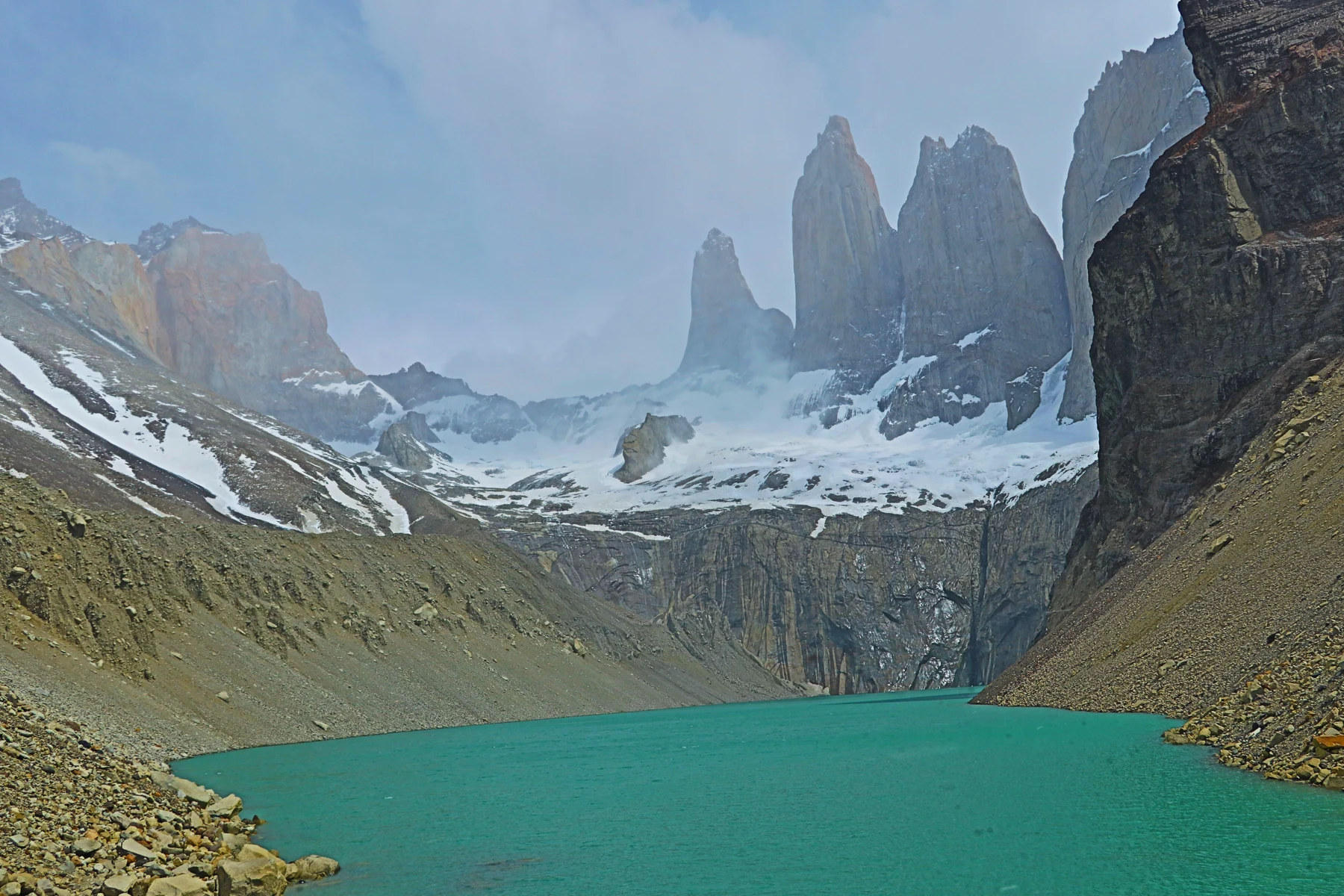
Las Torres, Torres del Paine, Chile.jpg by Aakerueh, CC BY-SA 4.0. Resized and converted to WebP.

The Torres del Paine towers walk usually means the Base Torres viewpoint hike. It is an exact trail day, not every visit to the national park. Check the allowed starting time and conditions before planning the ascent and return.
Plan Base Torres from the real trailhead and your return transport. The park publishes route rules and can restrict access for conditions. An earlier start must still fit those rules. Keep enough time to descend and reach your pickup. A guided product should say who walks the trail with you, not merely who drives to the park.
Base Torres hike overview
CONAF's visitor advice describe Base Torres and publish its access rules. Read them alongside the current notice. A generic tour of the park may visit roadside views without including this walk.
The park planning guide separates the towers day from the wider W and O. Choose the route you want before settling an entrance and transfer.
Trailhead and approach stages
Use the official map to see the Las Torres, Chileno and Base Torres links. Keep the starting and ending points on the same plan. Walking time depends on the route you take and your pace.
The route comparison below keeps each published distance with its source and endpoints. Use the version that matches your own start and finish.
| Task | Decision | Source to check |
|---|---|---|
| Reach the trail | Exact road drop-off | Your transport provider |
| Start walking | Current allowed entry | Park rule |
| Choose turnaround | Conditions and time left | Ranger advice and the route plan |
| Leave the area | Fixed or flexible pickup | Your road booking record |
Scroll for more →
The eastern approach starts in the Las Torres sector. Laguna Amarga is the park entrance used by this approach, but it is not the start of the full walk described in a tour. In its Classic W itinerary, Vertice takes visitors through Laguna Amarga to the Welcome Center and Central sector. That distinction matters when choosing a bus. A ticket ending at the entrance still leaves the transfer to the walking start to resolve.
The ascent follows the Ascencio Valley, passes the Chileno area and continues through forest before the last rocky climb. Vertice describes the last part as a field of large rocks. A steep finish after hours on foot is a different task from a smooth path of the same length. Turn back if instructed by staff, but do not invent a shortcut over the rocks to save time.
Chileno is a useful named point for reading your plan. A night there changes the next day's start compared with sleeping at Central or returning to Puerto Natales. It does not remove the ascent or give permission to ignore access hours. Ask which starting point your walking estimate uses. Keep that answer beside the actual bed and transport bookings.
Distance ascent and estimated effort
Two official or first-party descriptions use different measures. CONAF's 2026 advice lists 7 km, 8 hours return and medium/high difficulty for Base Torres. It does not clearly label the endpoints of its distance.
Vertice's Classic W gives 21 km and 8 to 10 hours for its full Central-based day, including the return. Both were checked October 2026. These figures should not be merged into a claim that the full Welcome Center return is only 7 km.
For an organised day using the Central start, the longer operator estimate is the useful planning comparison. For another start, ask for its own return distance. If a seller advertises a much shorter outing, ask whether it stops below the viewpoint or begins after an overnight higher on the approach. The word Base in a tour title cannot answer that.
Vertice places the viewpoint at about 900 metres above sea level. That is an altitude, not 900 metres of cumulative ascent. We have not converted it into a climbing total. Elevation gain requires a route with defined endpoints and a stated method. For effort, the published long return day and rocky final ascent are more useful than an unsourced climbing figure.
Assess whether everyone can descend the same rough ground after the climb. A strong uphill pace does not establish knee comfort on the way down. If your party has different speeds, arrange the guide's regrouping and turnaround plan before leaving. A split group must not depend on a mobile signal to meet again.
Turnaround and weather decisions
The return is part of the hike. Do not spend all the available time reaching a viewpoint and then discover that the descent misses your transport. Set a conservative turnaround that fits the park's real rule.
Cloud may hide the towers even when walking is allowed. A scenic photo does not prove the view on your date. Choose the walk for its route and be prepared to turn back when conditions or time need it.
Set the day's latest return from the earliest firm constraint: a ranger limit, your guide's turnaround or the transport pickup. Work backwards from that point. Include stops and the descent, rather than treating the published walking time as the whole door-to-door day. If the available window is shorter than the route estimate, change the plan before you start.
At the rocky final approach, assess footing and conditions again. A viewpoint photo cannot show ice underfoot or strong gusts on your day. CONAF warns that weather can change quickly and asks visitors to carry layers for rain, wind and snow. Its advice also says that interior trails lack phone and internet signal. Carry the route and booking details offline.
Turn around if the allowed window or your party's ability no longer supports the return. Do not stay at the lake waiting for cloud to clear if that uses the descent margin. Reaching the viewpoint in poor visibility is possible; clear towers are never an inclusion a guide can deliver on demand.
Current access and restrictions
The park's homepage carries seasonal mountain-trail guidance. Its September notice discusses the end of a winter guide need while retaining condition-dependent precautions. This is a reason to check the present rule, not to assume every season has the same access.
Park entry does not guarantee trail access. A bed near the route or a tour sold online also does not override a closure. Ask the park if the published pages leave the current limit unclear.
CONAF's 2026 visitor recommendations list entry to Base Torres until 09:00, an exit time of 15:00, and no separate trail reservation. These are the times printed for this walk, checked October 2026. They are distinct from the park's general opening hours. Clarify the checkpoint to which a time applies with the ranger before starting, rather than guessing from your bus arrival.
The Pases Parques notice gives a winter guide period of 27 April to 15 September 2026, with an extension if winter conditions justify it. CONAF's homepage says the accredited-guide requirement ends from 16 September, while retaining microcrampons and poles as a safety requirement. These dated notices are not a rule for every future year. Recheck equipment and access near departure.
The map page also prints summer reference cutoffs for individual links. They do not replace the more specific current Base Torres advice. If a printed route table and the day’s ranger instruction differ, follow the ranger. Buying a park pass or sleeping at Chileno does not authorise late movement.
No trail reservation is not the same as no booking tasks. You still need park admission. Any overnight stay must be reserved with its manager, and your road transfer must reach the correct start. Keep these three tasks separate so a seller's inclusion list can be checked properly.
Guided day hike or independent plan
A guided day can arrange the walking leader and road journey together. Read who stays with the group on the ascent and return. A transport-only product does not supply trail guidance.
Use W booking planning when the towers fit into an overnight trek. The next bed changes how the day is planned.
Choose the walking plan
Compare the W Trek tour options by real guide coverage and overnight sequence.
A guided day works best when the walking leader stays with the party through the ascent and descent. Confirm that coverage explicitly. A transfer with a briefing can still be a self-guided walk. Ask who decides the turnaround and what happens if one walker cannot continue. The answer should cover the return of that person as well as the rest of the group.
An independent plan needs a realistic full-day pace and a settled exit. If you use a return bus, check the connection from the walking finish back to its stop. If you sleep in the park, check the meal and check-in window at the actual property. A flexible evening in town cannot rescue an unsuitable trail start.
For a multi-day booking, treat Base Torres as a substantial walking stage rather than a small arrival activity. Vertice's published 8 to 10 hour day is a useful warning against placing it after a late flight or border transfer. Choose a shorter allowed outing when the arrival day cannot support that commitment.
Questions and next planning step
Does every park tour walk to Base Torres?
No. A park tour can focus on roadside sights or other walks. Ask whether Base Torres is included and where the trail day starts and ends. Check who guides it, the current access and the pickup. The word towers in marketing copy is not enough to prove the real hike.
Do I need to book an overnight stay for a day hike?
An overnight booking is a separate choice. Plan the day from your real base and return transport. If you are joining the W, the overnight sequence matters too. Do not confuse a room near the trail with access to walk, and do not infer current access from a lodging calendar.
Is the towers viewpoint always visible?
No. Cloud and weather affect visibility. An allowed trail does not guarantee a clear view at the end. Keep the turnaround based on conditions and time rather than waiting indefinitely for cloud to lift. The return and your transport still need to fit the whole day.
Can I walk later because summer has long daylight?
Use the park's route rule. A latest entry or return rule can be earlier than sunset. More daylight does not override that rule or make a long ascent right at any hour. Start only under the current allowed plan and leave enough time for the descent at your pace.
Sources and facts last checked
Checked October 2026: CONAF's advice, map and seasonal notice on the park homepage. Current conditions govern the day; no viewpoint visibility is promised.
Verdict on Torres del Paine towers
Choose the Torres del Paine towers walk as a full ascent-and-return day. Match its allowed start to your transport and follow current rules. Turn back with enough time to finish the route safely.