
Torres del Paine National Park Camping: Sites, Managers and Walking Stages
Arrange Torres del Paine National Park camping as a complete route. Compare pitch-only and supplied-tent products, meals, managers and booking terms.
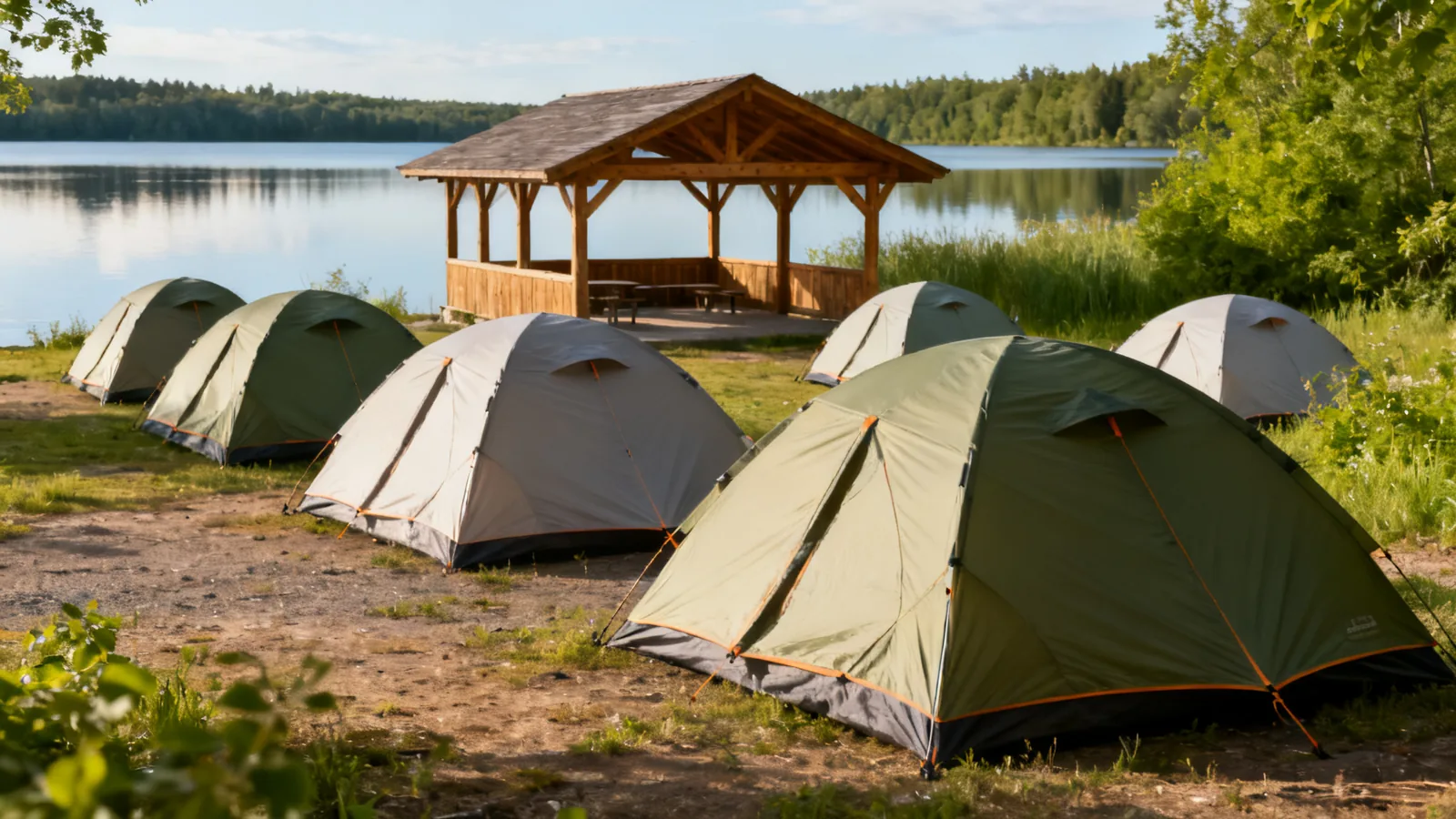
Illustrative scene: small tents at an orderly lakeside campsite with a shared wooden shelter.
Torres del Paine National Park camping needs a route-linked overnight plan. Check what your campsite booking supplies. It may be a pitch for your own tent. It may include a tent, or offer equipment and meals as a package. Reserve the whole sequence rather than one isolated night.
Choose campsites from the stages you can walk under current park rules. Check each manager's real product and booking record. A furnished camping product differs from a space for your own tent. Meals may be separate. Park entry and transport need their own bookings unless included. If one night cannot be secured, change the sequence before treating the trek as confirmed.
Campgrounds by route
CONAF's official map shows overnight nodes on the trekking circuits. Use it to link the day's start with its end. Do not choose campsites from a list without checking whether the stages link.
The park guide explains the broad W and O choice. The back-side circuit has its own seasonal rules. A camping listing does not prove that the approach is allowed on your date.
The ordinary W overnight choices span two operators. Las Torres' camping page, checked October 2026, lists Central, Chileno, Cuernos, Frances and Seron. Vertice's accommodation directory lists Paine Grande, Grey, Dickson and Los Perros. Seron, Dickson and Los Perros form the northern O route. A normal W does not need these extra stops.
| Overnight sector | Manager | Route role |
|---|---|---|
| Central | Las Torres | Eastern base for the towers return and the lakeside W stage |
| Chileno | Las Torres | Higher overnight option on the Base Torres approach |
| Cuernos | Las Torres | Eastern side of the W near Lake Nordenskjold |
| Frances | Las Torres | W sector closer to the French Valley junction |
| Seron | Las Torres | Northern circuit after the eastern start |
| Dickson | Vertice | Northern circuit before Los Perros |
| Los Perros | Vertice | Camping before the John Gardner Pass stage |
| Grey | Vertice | Western W sector and overnight after the pass |
| Paine Grande | Vertice | Western transport connection and W overnight base |
Scroll for more →
The table locates booking responsibility; it does not establish availability. A site can appear in a directory while its linking trail is closed. The October 2026 ticket notice keeps the Paine Massif circuit closed through 31 October. A review is needed before reopening. Check that before buying the northern nights.
Stage distances between the overnight sectors
These figures come from Vertice's Classic W and Classic O programmes, checked October 2026. They belong to those named endpoints and itinerary versions. A valley detour changes the total; a campsite's similar name is not enough to transfer the figure to another start.
| Published stage | Distance | Estimated walking time |
|---|---|---|
| Eastern Welcome Center start to Seron | 15 km | 4 to 5 hours |
| Seron to Dickson | 19 km | 6 to 7 hours |
| Dickson to Los Perros | 12 km | About 5 hours |
| Los Perros to Grey via the pass | 18 km | 10 to 12 hours |
| Grey to Paine Grande | 11 km | 4 to 4.5 hours |
| Paine Grande via the valley to Frances or Cuernos, O version | 15 or 18 km | 7 to 8 hours |
| Cuernos or Frances to Central | 12.5 or 16 km | 4 to 6 hours in the O programme |
Scroll for more →
Chileno sits on the towers approach rather than the lakeside sequence in this table. Its overnight position can change a towers day. Use the defined route in your booking rather than inserting Chileno into the Central-to-Cuernos distance. The full towers return from Central is 21 km and 8 to 10 hours in that plan. Keep it separate from the camp-to-camp stages.
The pass day is the key O constraint. A vacant site beyond it does not make a 10 to 12 hour stage right for everyone. Check your ability to carry the booked load and the park's current pass rules. Do not remove Los Perros merely to bypass a sold-out night without a properly supported alternative route.
Reservation managers and booking order
Vertice's lodging page lists Paine Grande, Grey and Dickson lodging and Los Perros camping. Las Torres publishes its own lodging products. These are supplier sources for the services they manage, rather than park-wide access.
Check the named manager for each selected stop. Reserve a coherent route, then compare the booking records. A payment receipt from one company cannot prove a night controlled by another.
| Camping product | Confirm | Trade-off |
|---|---|---|
| Pitch only | What space is supplied | You remain responsible for the required sleeping setup |
| Supplied tent | Which sleeping items are included | The product can differ by site or date |
| Camping package with meals | Exactly which meals and nights | Less scope to change individual services |
| Mixed camping and refugio | Bed type for each stop | Different room and equipment plans within one trek |
Scroll for more →
Older maps and trip reports mention Torres, Italiano and Paso as CONAF campsites. The park's English visitor bulletin, a 2025/26 document, marks these campsites closed. It was checked October 2026 but is not a new 2026/27 camping calendar. Do not treat them as free substitute nights without a current explicit park confirmation.
Italiano and Paso also remain useful ranger or route references. Seeing a ranger symbol at one of them does not prove a visitor camping product. A route description can pass a closed campsite without allowing an overnight there. Keep the booking role and the map role separate.
Facilities meals and accommodation inclusions
Read the product for the real site. Do not assume that all campsites have the same facilities or that every supplied tent includes the same items. Ask the manager for a written answer to anything that affects your choice.
Check meal dates and service rules. An arrival dinner is different from lunch on the trail. If meals are key to your plan, put them beside the correct night. Avoid treating them as a general package benefit.
Las Torres describes three camping products: fully equipped, semi-equipped and individual pitches. Its semi-equipped version includes the tent and mat, while the fully equipped version also lists a sleeping bag and pillow. The pitch product is for your own setup.
The checked page limits a site to two people. A party of three needs an extra booking. Do not assume a larger tent space is included.
Cooking is site-specific. Las Torres permits portable stoves only in designated shelters at Central, Seron and Frances, and prohibits stoves in the Chileno sector. A reservation with no meals therefore needs a workable food plan under that sector's rules. Do not carry a stove as a substitute for confirming where it may be used.
Los Perros has shared bathrooms and cold-water showers, according to Vertice, checked October 2026. It provides a sheltered cooking area and says cooking is not allowed in tents or outdoors. This is a remote campsite, not a refuge bedroom with a hot-shower guarantee. Its early 07:00 checkout also matters before the pass stage.
Write down the equipment supplied at each stop. Mixed operators can mean different bedding and tent arrangements within one trek. If a bag, mat or meal is missing from a record, ask before leaving town. Fixing it at the first camp may not solve the later night where you need it.
Check-in and park rules
Keep every overnight booking record accessible without a signal. Check names and dates before leaving town. Follow the site manager's check-in rules and the park's route rules.
Camping must follow the allowed plan. A full site is not access to pitch somewhere nearby. If the sequence fails, settle a new allowed route before travelling.
Availability and cancellation
Read each manager's amendment terms. Moving one night can make the next stage unworkable. Confirm the full new sequence before treating a date change as solved.
Use the park entry guide for the separate entry task.
Compare a booked W stay
Use the W Trek package comparison when you want the overnight sequence handled together.
Questions and next planning step
Does camping mean I need my own tent?
It depends on the exact product. A pitch-only booking and a supplied-tent booking are different purchases. Read the inclusion list for each night and ask about any missing item. A package title does not prove the sleeping plan at every campsite in its route.
Can I reserve one campsite and arrange the rest later?
One booking does not confirm the full trek. Check the whole overnight sequence before buying other fixed services. If a needed night is unavailable, change the route or dates. Do not assume you can camp elsewhere without access or walk an unsuitable stage to bridge the gap.
Is camping included in my park pass?
Do not infer it from entry. Campsites and refugios are booked as overnight services unless a real package explicitly combines them with park entry. Keep the separate booking records. The pass also does not override rules on a linking trail or guarantee a place at a chosen campsite.
Can I move every night if the weather is poor?
Only under the managers' real terms and available alternatives. A flexible transport ticket does not make the beds flexible too. Check each affected night and the resulting stages before moving the trek. A reserve day works only when the route and services can accommodate the change.
Sources and facts last checked
Checked October 2026: CONAF's map, Vertice's overnight listings and Las Torres' lodging details. Date-specific availability and facilities belong to the exact product booking record.
Verdict on Torres del Paine National Park camping
Reserve Torres del Paine National Park camping as a complete walking sequence. Read the sleeping setup and meals for every night. Keep entry and transport visible as separate bookings.